
Partenaires






Menu


Rechercher
Navigation


Accueil > The LPNHE > Informations Equality-Discriminations
Informations Equality-Discriminations
by Francois Legrand - 16 December 2024
Presentation
Following the agreement on professional equality between women and men in the civil service dated of November 30, 2018, the appointment of an equality officer is mandatory within ministries and public institutions.
At LPNHE, the equality and discrimination officer is Sophie Trincaz-Duvoid. She was appointed by the director of the laboratory and serves as the representative for the laboratory’s three funding agencies: CNRS, Sorbonne University, and Université Paris Cité. Her role is to assist the unit director in implementing the unit’s action plan, incorporating the priority areas defined at the national and regional levels.
Managements
The various funding agencies of the laboratory actively implement policies to fight against all discrimination. On the following websites (in French), you will find news, information, and equality plans from these organizations:
The Ministry of Higher Education and Research pursues a determined policy to combat all forms of discrimination, including sexist and sexual violence, racial discrimination, and anti-LGBT+ discrimination. National plans, actions and calls for projects have been implemented to fight discrimination in higher education and research.
More information at https://www.enseignementsup-recherche.gouv.fr/fr/egalite-et-lutte-contre-les-discriminations-49928.
The CNRS promotes diversity in profiles regardless of gender, disability, or social, ethnic, or geographical origins, aiming to offer as many people as possible the opportunity to join a leading research institution. Through its Mission for Women’s Place, it also acts as an observatory responsible for promoting, advising on, and evaluating gender considerations in the institution’s overall policies.
Sorbonne University, to advance gender equality, has established an Equality Mission which promote professional equality between women and men, ensure equal treatment of female and male students, and fight against gender-related discrimination and violence.
On a broader level, the university has also appointed a Secularism Officer, a Racism and Antisemitism Officer, and a Mediator.
Through its Equality, Diversity, and Inclusion Mission, Université Paris Cité is committed to promoting equality, diversity, and inclusion across its community and fighting against all forms of violence and discrimination, particularly those related to gender, disability, racism, antisemitism, and LGBTphobia.
Useful resources:
For gender-neutral writing: A practical guide created by the High Council for Gender Equality (in French).
Numbers
The 2024 Women and Science Report (in French) by the Academy of Sciences.
Some statistics on violence against women in higher education and research:
- 1 out of 10 female student, victim of sexual assault since her arrival in higher education (Source: Observatoire étudiant des VSS dans l’enseignement supérieur, Baromètre des violences sexistes et sexuelles dans l’enseignement supérieur, 2023)
- More than 8 out of 10 female researchers declare they have personnaly gone through at least one instance of sexism int heir caree (Source: IPSOS, Harcèlement sexuel et sexisme au sein du monde scientifique, 2023)
- 1 out of 2 women scientists reveal they have personnally gone through at least one sexual harrassment situation during their career (Source: IPSOS, Harcèlement sexuel et sexisme au sein du monde scientifique, 2023)
VSS
VSS (in French) are Gender-based and sexual violence. It refers to acts ranging from Public/private insult (gender-based and/or homophobic) to rape, including sexual harassment and sexual assault.
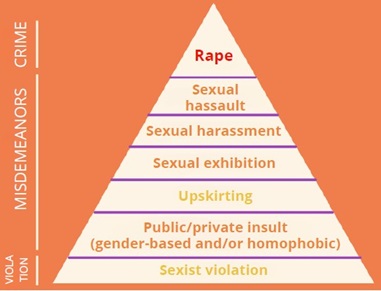
Sorbonne Université developped a memo to identify and fight against sexual harassment (in English) and a document on how to get help (in English).
To learn about and defend against situations of gender-based and sexual violence, a practical guide (in French) was created and updated in 2020 with the support of the Ministry of Higher Education, Research, and Innovation.
Better understand the concept of consent, explained through the analogy of offering a cup of tea — available in English.
Report
Reports must be made to your employer and, if applicable, to the employer of the person being reported. The procedures to follow for each of the laboratory’s funding agencies are detailed on the following pages:
Filling a report does not prevent you from also lodging a complaint at the police station if the situation warrants it. Both actions can be carried out simultaneously.
Within the laboratory, whether you are a witness or a victim, several contacts are available to listen and provide support: the director, the Equality Officer (Sophie Trincaz-Duvoid), or the Prevention Assistants (Carla Carvalhais and Alexandre Lantheaume).
Do not hesitate to contact any of them if needed.
Tests
The violentometers
The violentometers are tools designed to help identify ambiguous or potentially dangerous situations. Several versions exist:
-The violentometer for research and higher education, available in English.
-The violentometer (in French) on consent in romantic relationships.
-The Safe Prof, or violentometer (in French) for relationships between teachers and students.
A quiz on women and girls in science (in French)
They are researchers, inventors, technicians, well-known or less recognized, at CNRS and around the world: test your knowledge about women scientists and equality in research.
Take the quiz (in French) here.
Testing implicit biases (in English)
To explore your own implicit biases, Harvard University offers various tests (Implicit Association Tests) on topics such as “Gender-Science,” “Gender-Career,” “Age,” “Skin-tone,” and more.
Take the tests here.
Stéréotypes, préjugés et biais
Do you know what these French terms mean?
Find the answers here

Ecrire sans stéréotypes - 1,4 Mb |
Guide VSS - 1,6 Mb |
How to get help - 211,6 kb |
|
Les types de VSS - 778,8 kb |
Memo_harassment_EN - 1,7 Mb |
Rapport Femmes et Sciences - 7,4 Mb |
|
Safe Prof - 240,8 kb |
Violentometre couple - 180,3 kb |
Violentometre ESR anglais - 228,9 kb |
|
Violentometre ESR francais - 98,8 kb |

Also in this section :
- Présentation des activités
- Organigramme
- Accès et Hébergement
- Informations pratiques pour les personnels
- Informations Egalité-Discriminations
- Liste des thèses des personnels du LPNHE
- Pages du personnel permanent
- La vie du labo
- Accueil d’entrants et de visiteurs
- Rapport d’activité et publications
- Instances du laboratoire et chargé.es de mission
- Évaluations de l’unité
- Développement durable
